Turn Your Search Into a RAG-Powered System, Not Guesswork
Frequently asked questions:
How hybrid retrieval, local language models, and citation verification help turn AI search from a demo into a practical business system.
Is Your AI Answering from Knowledge — or Guessing?
Large Language Models have changed how users expect to interact with software. Instead of clicking through filters, menus, manuals, or static search results, people now expect to ask a question in natural language and receive a useful answer immediately.
But there is a problem: a language model does not automatically know your internal documents, your product catalog, your compliance rules, or your latest operational data. And when it does not know something, it may still produce an answer that sounds confident.
That is where Retrieval-Augmented Generation, or RAG, becomes essential.
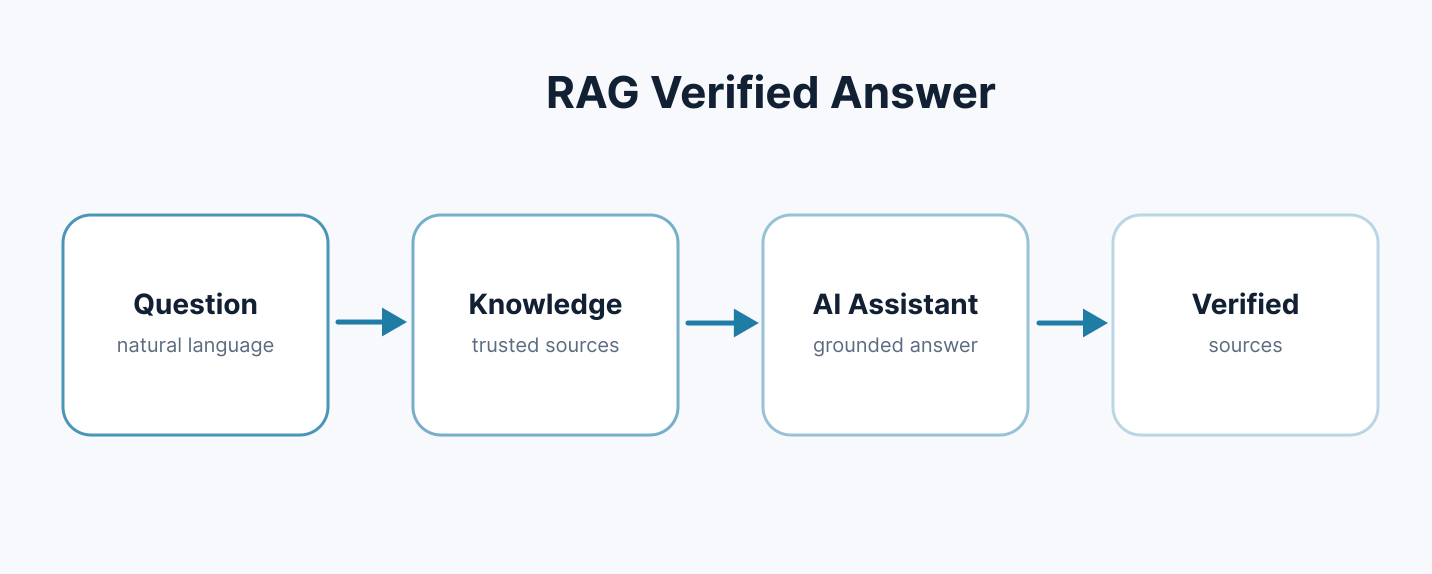
RAG connects a language model to trusted business data. Before the model answers, the system searches relevant documents, catalog records, policies, or knowledge base entries and passes that context into the prompt. The model is no longer answering only from its general training. It is answering from information retrieved at query time.
In practice, this makes AI systems more useful, more current, and much easier to verify.
The Business Problem: Traditional Search Is Too Literal
Many business systems still rely on keyword search. That works when users know the exact terminology stored in the database. But real users rarely search that way.
A customer may describe a product by use case instead of model number. An internal team member may ask a compliance question in plain language instead of referencing the exact document title. A support specialist may remember the meaning of a policy but not the phrase used in the PDF.
Traditional search often fails in these cases because it matches words, not intent.
At the same time, using a standalone chatbot without grounding is risky. It may produce fluent but unsupported answers. For business-critical use cases — compliance, finance, legal workflows, product recommendations, technical documentation, or risk monitoring — that is not acceptable.
The goal is not just to add “AI” to a search box. The goal is to build a system that can:
- understand natural language questions;
- retrieve the right information from trusted sources;
- answer with business context;
- show where the answer came from;
- avoid making unsupported claims;
- remain reliable when traffic, data, or AI services change.
That is the real value of RAG.
Our Strategic Approach: Design RAG Around the Problem, Not the Hype
One of the most important lessons from building RAG systems is that there is no single “best” architecture.
A RAG system for internal compliance documents should not be designed the same way as a product-discovery assistant for a public website. The first case prioritizes accuracy, traceability, and privacy. The second prioritizes speed, conversational flow, and user experience.
We worked with two different RAG patterns:
- A local knowledge assistant for trusted document search, where privacy and citation accuracy were the highest priorities.
- A product-discovery chat experience for a large catalog, where the assistant needed to understand user intent and surface relevant items quickly.
Both systems used the same core principle — retrieve trusted data before generating an answer — but the implementation choices were different.
That distinction matters. Successful AI integration is not about choosing the biggest model or the most fashionable tool. It is about matching architecture to business risk, data sensitivity, expected traffic, and user behavior.
Technical Solution 1: Local Knowledge Assistant with Citation Verification
The first system was designed for a high-trust environment: answering questions over official documents, internal procedures, and regulatory-style content.
In this type of workflow, a wrong answer is not just inconvenient. It can create operational, compliance, or legal risk. So the architecture was built around one principle: the answer must be grounded in retrieved sources.
Hybrid Retrieval: Semantic Search + Keyword Search
Pure semantic search is good at understanding meaning. It can connect a user’s question to a relevant passage even when the words are different.
But semantic search can miss exact references — article numbers, codes, acronyms, product identifiers, legal terms, or technical names.
Keyword search has the opposite strength. It is precise with exact matches but weak at understanding intent.
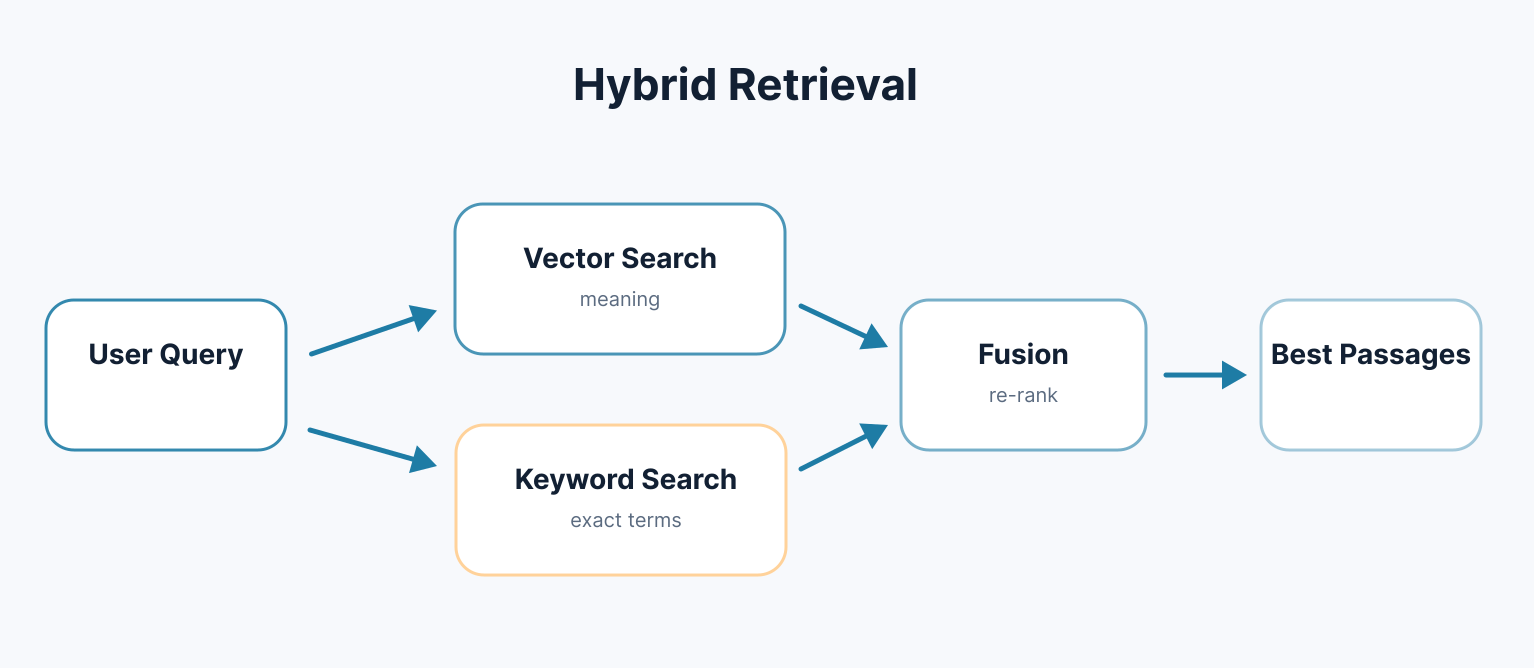
That is why a hybrid approach is often stronger than either method alone. The system runs both:
- Vector search to find passages with similar meaning;
- Keyword search to catch exact terms and references;
- Result fusion and re-ranking to combine the strongest matches.
This improves retrieval quality, especially in domains where both language meaning and exact terminology matter.
Smart Chunking: The Quiet Detail That Defines Quality
Documents are rarely useful as one large block of text. A 200-page PDF cannot simply be passed into a model for every question. The system needs to split documents into searchable pieces.
This process is called chunking, and it has a major impact on quality.
If chunks are too large, search results become noisy. If chunks are too small, the model loses context. A good RAG pipeline splits content along natural boundaries — paragraphs, sections, headings, and sentences — while preserving enough overlap to keep meaning intact.
In practice, chunking is not a minor preprocessing step. It is part of the product experience. Bad chunking produces bad answers, even with a strong model.
Metadata Filtering: Narrow the Search Before the Model Sees It
For document-heavy systems, metadata is a major advantage.
Each document can carry structured labels such as jurisdiction, document type, version, date, department, language, or status. These filters can be applied before retrieval, so the system searches only the relevant subset of information.
For example, a user may need answers only from the latest version of a policy, only from a specific region, or only from a particular document category.
Filtering before generation makes the system faster, cheaper, and more accurate.
Citation Verification: The Trust Layer
For high-stakes RAG, citations should not be treated as decorative links. They are part of the safety layer.
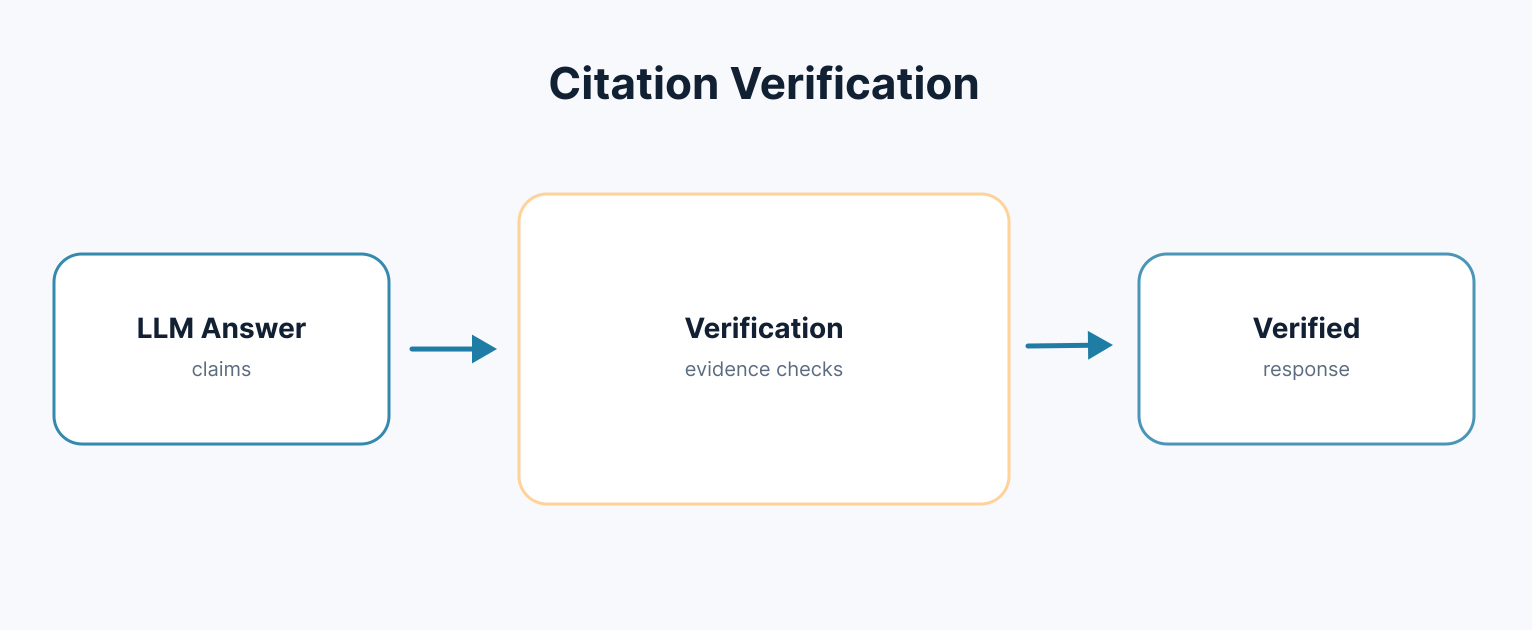
The model can be instructed to cite its sources, but instruction alone is not enough. The system should verify that cited passages actually exist in the retrieved context and that the answer does not introduce unsupported claims.
A practical verification layer can check:
- whether the cited source was actually retrieved;
- whether quoted text appears in the source;
- whether each important claim is tied to evidence;
- whether the model is trying to answer outside the provided context.
This changes the experience from “trust the AI” to “inspect the evidence.”
For internal users, that distinction is critical.
Technical Solution 2: Agentic Product Discovery Chat
The second system had a different goal: helping public website visitors find products in a large catalog through natural conversation.
Here, the main challenge was not only factual accuracy. It was intent understanding.
Users do not always know the exact product name, category, size, specification, or model number. They describe their needs in human language:
- “I need something for a small room.”
- “Show me cheaper alternatives.”
- “Which option is easier to install?”
- “Compare the first two.”
A rigid search interface struggles with this. A conversational assistant can handle it better — but only if it has access to live catalog data.
Tool-Calling RAG
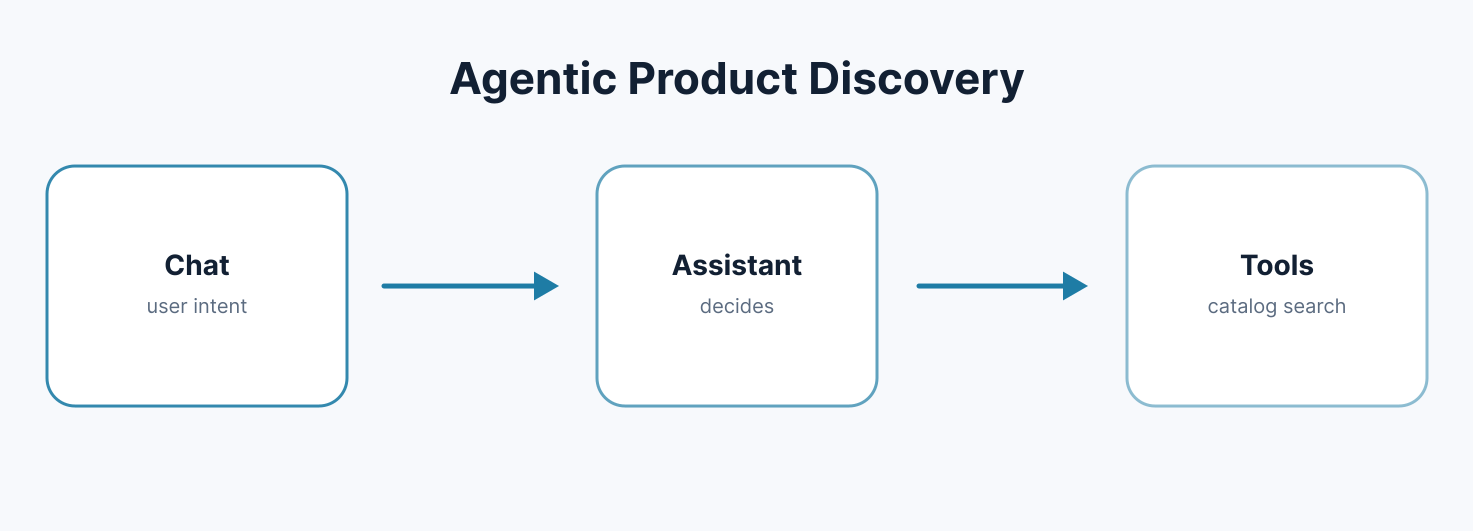
Instead of retrieving information before every response, the assistant can decide when it needs to call a search tool.
This is often called agentic RAG or tool-calling RAG.
The assistant reads the user’s message, decides whether catalog data is needed, calls a product search function when appropriate, and then uses the returned results to compose a helpful reply.
This pattern is powerful because it supports a more natural flow:
- search when the user asks for products;
- refine when the user adds constraints;
- compare when the user selects options;
- answer directly when the message does not require retrieval.
It also avoids unnecessary AI calls and keeps simple interactions fast.
Query Expansion for Better Matching
Real user queries are often vague. A small query-expansion step can improve retrieval by rewriting the user’s request into richer search terms while preserving intent.
For example, a short phrase can be expanded with related terms, synonyms, use cases, or category hints before being passed to the search engine.
This helps bridge the gap between casual language and structured catalog data.
Graceful Fallbacks
Production systems need fallback behavior. AI services can be temporarily unavailable. Rate limits can happen. A model provider can change performance characteristics. Network latency can spike.
For public-facing search, the user should still receive useful results even if the AI layer fails.
A practical design can fall back to traditional keyword search or filtered catalog search. The experience may become less conversational, but it does not become broken.
That is an important difference between a demo and a production-ready AI feature.
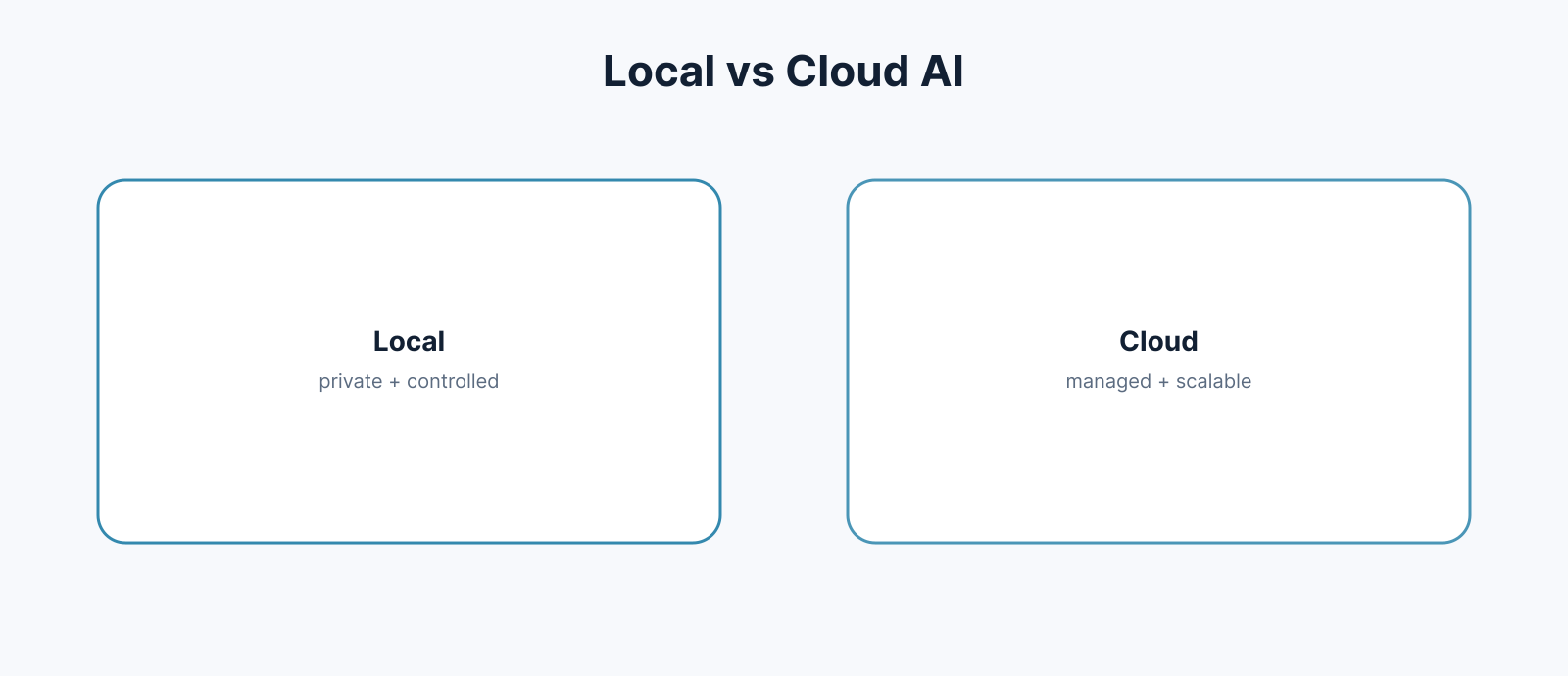
Local Models vs Cloud Models: Choosing the Right Deployment Strategy
A major architectural decision in any RAG project is where the language model runs.
For sensitive internal systems, local or self-hosted models can be a better choice. The data stays inside the organization’s environment, costs are more predictable for steady internal usage, and the system can operate under stricter privacy or network requirements.
For public-facing systems, cloud models may be a better fit. They offer strong language understanding, managed scaling, and lower operational complexity when traffic is unpredictable.
The decision should be based on business constraints, not ideology.
A useful rule of thumb:
- Sensitive data, strict privacy, steady internal usage: consider local or self-hosted models.
- Public data, high language complexity, unpredictable traffic: consider managed cloud AI APIs.
In both cases, the model is only one component. Retrieval quality, data preparation, monitoring, and fallback behavior often matter more than model size.
What Business Teams Gain from RAG
A well-designed RAG system can improve more than search quality. It can change how teams and users interact with business knowledge.
Better Access to Internal Knowledge
Employees can ask questions in plain language instead of searching through folders, PDFs, wikis, and outdated documentation.
More Useful Website Search
Visitors can describe what they need, even if they do not know exact product terminology.
Lower Support Load
When users can find answers or products more easily, fewer simple questions reach support teams.
Faster Knowledge Updates
Unlike model training, RAG systems can be updated by changing the underlying documents, catalog records, or knowledge base entries.
Greater Trust
When answers include sources and verification, users can inspect the evidence instead of relying on a black-box response.
Key Lessons from Implementation
Retrieval Quality Matters More Than Model Size
If the wrong documents are retrieved, the model will produce a weak answer. Improving search, chunking, filters, and ranking often delivers more value than switching to a larger model.
Hybrid Search Is Usually Worth It
Semantic search is excellent for intent. Keyword search is essential for exact terms. Combining both creates a more reliable retrieval layer.
Chunking Is Product Work, Not Just Preprocessing
The way documents are split directly affects answer quality. Good chunking preserves meaning; bad chunking creates confusion.
Citations Need Verification
For business-critical systems, source links are not enough. The system should verify that the answer is actually supported by retrieved content.
Architecture Must Follow the Use Case
A compliance assistant, a product search chatbot, a support knowledge base, and a risk-monitoring tool all need different RAG designs.
Production AI Needs Fallbacks
A reliable system should degrade gracefully. If the AI layer fails, users should still get useful search results.